Since ChatGPT revolutionized artificial intelligence by demonstrating the power of the transformer architecture on text generation, this same architecture has been successfully adapted to a wide range of use cases: from images to video. But so far, no one had managed to bring its power to sports comprehension, for lack of a dataset massive enough to train on.
We just closed that gap, for football.
The problem: every new stat needs its own AI, trained from zero
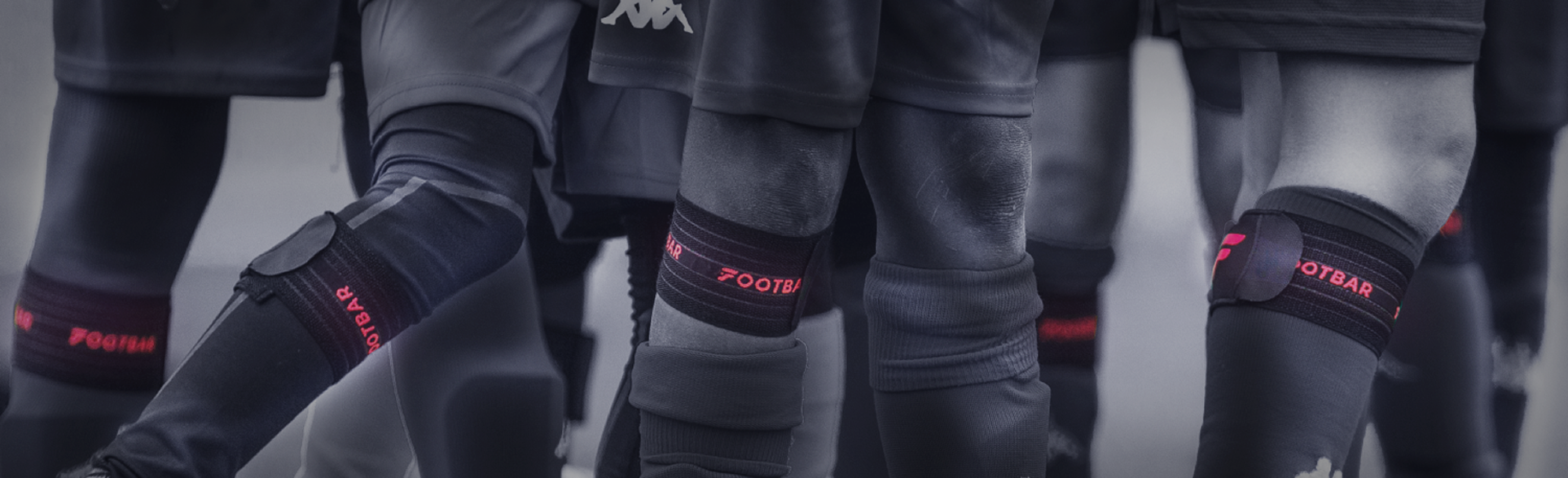
Thanks to the deployment of the Footbar technology, every player wears a small sensor on the leg that measures acceleration: how the leg moves, 50 times a second, all match long. From that raw signal, we extract stats: kicks, sprints, distance covered, running speed, and more.
Historically, each new stat meant building a brand-new AI model, trained from scratch, for that one job. And training a good model needs labeled data: real matches where someone has manually gone through the footage and tagged, second by second, “this is a kick,” “this is not.” That’s slow, expensive, and has to be redone every time we want to measure something new.
What we built: one AI “brain” that already understands football movement
Instead of training a new model per stat, we built TransMTR: a single AI model trained once on the movement data from over one million football sessions; likely the largest database of football-specific body movement ever assembled.

Here’s the trick that makes it work like ChatGPT: we didn’t need anyone to manually label those million sessions. The model learned the general “grammar” of football movement on its own, the same way ChatGPT learns the grammar of language just by reading huge amounts of text without a teacher grading every sentence.
Once trained, this model is frozen: we don’t retrain it. It just sits there as a reusable foundation, and small, lightweight modules are plugged on top of it for each specific stat we want.
The payoff: accurate stats with far less manual tagging
This is where it gets interesting for coaches and players. We tested this foundation model on two very different tasks: detecting kicks (a discrete event) and estimating running speed (a continuous measurement), and compared it against a traditional model trained the old way, from scratch, on the same task.
For kick detection, when we gave both models only a tiny amount of manually labeled data (about 1% of what’s normally needed), the old-school model was basically guessing: while our foundation model was already performing strongly, because it had already learned what football movement looks like from its massive unlabeled pretraining.
For running speed, the story is a bit more nuanced: with very little labeled data, both approaches performed similarly, and the traditional model pulled ahead once given the full labeled dataset. But we found a simple fix: instead of asking the foundation model’s add-on module to judge speed from a single instant, we let it briefly glance at a couple of seconds around that instant, much like a coach wouldn’t judge someone’s running speed from a single freeze-frame. With that small change, our frozen foundation model matched and then beat the traditional approach, without ever needing to retrain the core model itself.

Why this matters for you
For players and coaches, this isn’t just an engineering detail: it changes how fast and how reliably new insights can reach the pitch:
- New stats, faster. Because the hard part (understanding raw movement) is already solved, adding a new metric no longer requires collecting and labeling thousands of matches from scratch.
- More consistent numbers. We also found that this approach produces far more stable results run after run than the traditional method: fewer surprises, more trustworthy season-over-season comparisons.
- Built on real, ecological data. Not lab conditions or curated highlight clips: over a million real sessions from amateur and grassroots football around the world, the same environment your own stats come from.

Read the full paper
This blog post is a simplified summary. For the full technical details: architecture, training setup, statistical results, and limitations, read the complete article: