EN
EN
 ID
ID

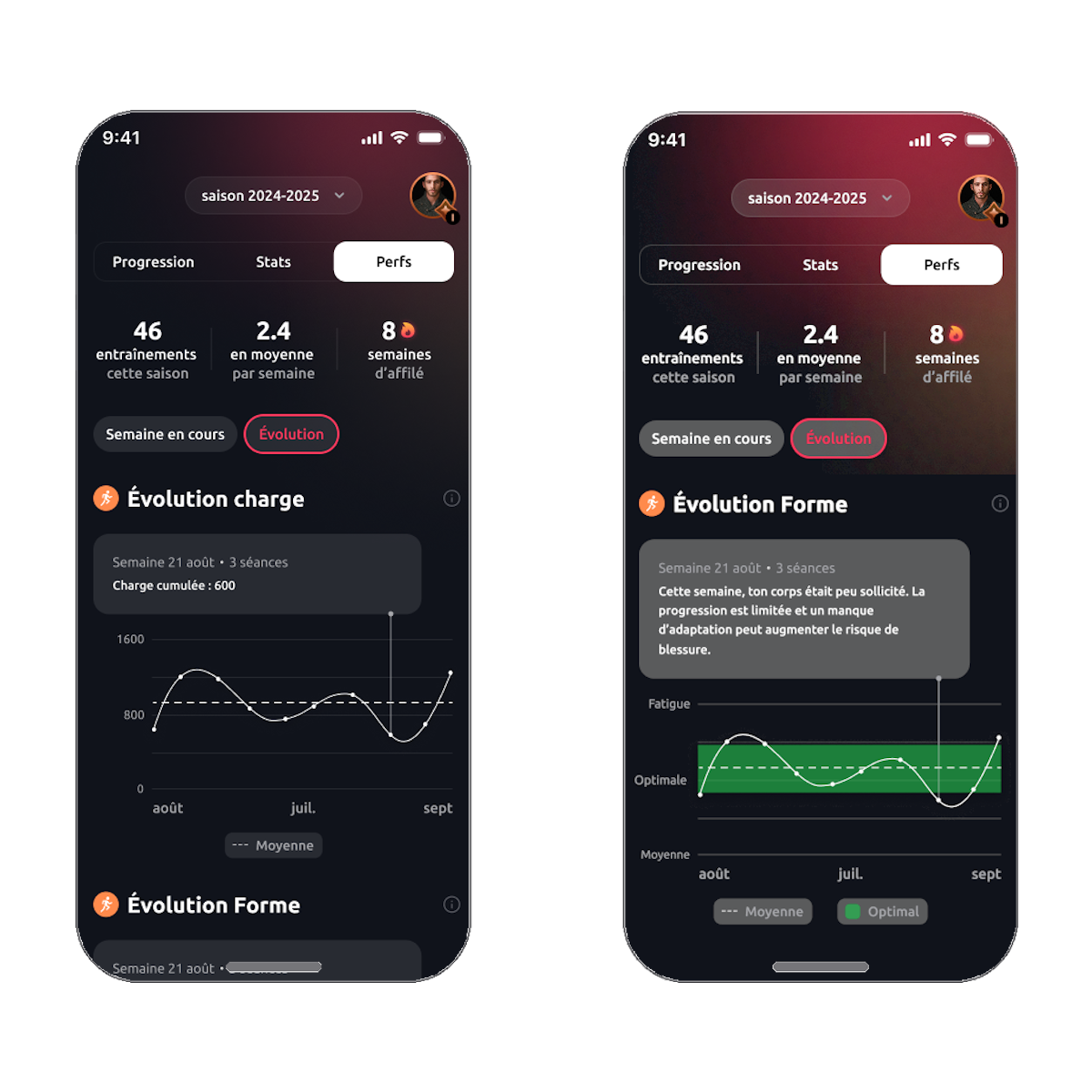
In football, whether you are playing in Ligue 1, at the amateur level, or are a young player in full growth, one question constantly arises: "Did I do too much or not enough?". Tracking your "load" (the total effort exerted during a session) isn't just a luxury for the pros. It is the number one tool for progressing without getting injured. For a young player, it protects their physical development; for an amateur, it ensures they are ready for Sunday's match. But beware: not all kilometers feel the same.
The Recipe for a Good Indicator
Most tools settle for measuring distance covered. It's a good start, but it hides the essentials. Imagine two players: the first jogs for 10 km, while the second performs 50 sprints and multiple shots over just 5 km. Who has put more strain on their tendons and joints? The second one, obviously. Yet, a traditional measurement would claim the first player "worked harder." To correct this, we must look at the mechanical intensity of the movements. We have developed a method that doesn't just look at whether you are moving, but how intensely you are doing so. To measure real fatigue, we focus where the action happens: on the leg.
Imagine a player making a lightning-quick start or a dead stop over just 2 meters. Their average speed remains low, but the effort provided by their muscles and tendons is colossal. By measuring leg acceleration, we capture these aggressive acceleration and deceleration phases that are the most taxing on the body, even at low speeds. And even better: this approach makes the invisible visible. A powerful shot or a precise long-range pass barely changes your torso's speed, but it represents an intense mechanical shock for your leg. By tracking the lower limb, our calculation naturally includes these fundamental technical gestures.
The "Formula" Under the Hood
For the curious, here is how these principles translate mathematically. This calculation transforms the thousands of vibrations captured by the sensor into a unique load score:
Footbar Load = α · ∫ tstart tend f(t) dt = α · ∫ tstart tend ( | ||a(t)||g - 1 | · 1{{ | ||a(t)||g - 1 | > 0,5 }})2 dt
In this equation, each step of our "recipe" is represented by a specific operation:
Signal Cleaning (| ||a||g - 1 |): This is the first step. The sensor on your leg constantly feels earth's gravity (the famous 1g). To isolate your real effort, the formula subtracts this "ghost weight." We only keep the net acceleration—the kind your muscles actually produce.
The Noise Filter (the 0.5g threshold): A footballer's life is made of micro-movements (shuffling, resting, adjusting socks). To avoid skewing your score, the formula ignores everything below a certain threshold. We only count "real" impacts that have a lasting effect on your fatigue.
The Intensity Amplifier (the square ²): This is the heart of the system. For the human body, one violent impact is much more traumatic than two small shocks. By squaring the acceleration, the formula gives exponential weight to explosive actions. A sprint or a shot will "weigh" much more than a jog, reflecting the actual mechanical stress endured by your joints.
The Total Dose (the integral ∫dt) : Finally, we don't just look at peaks. We calculate the sum of all this energy over the entire duration of the session.
The final result is multiplied by a factor α so that your session score is easy to read, generally falling between 100 and 200 units.
What This Changes for You
Thanks to this index, you finally know what your body has truly "endured." A very intense match with lots of duels and shots will result in a high score, even if you ran less than usual. It is this precision that allows you to adjust your next training session: if the score is too high, you rest the legs; if it's low, you can push a bit harder. This is the secret to longevity and performance, regardless of your level.
The goal is simple: train smarter, not necessarily harder.